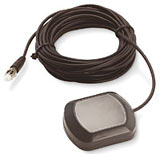
Most GPS receivers have an antenna built in to them. The two most popular types of antennas used in GPS receivers are “patch” and “quadrifilar helix” or “quad helix” for short. This page addresses external GPS antennas which are normally used when stronger satellite signals are needed.
(Browse all the other GPS articles and features.)
Many models are mounted magnetically to the roof of a vehicle. Models that are made for buildings are often mast-mounted. Most models are available with a wide range of connectors for all the various GPS receiver antenna jacks.
The reasons to need an
external GPS antenna:
- For use in a vehicle where the GPS receiver cannot or will not be placed near a window.
- For use when hiking under heavy tree cover or in canyons.
- For use in urban canyons (tall buildings).
- For use any place that the receiver doesn’t have a good view of the sky.
- To minimize temporary loss of signal when in a vehicle in motion.
- To maintain the best possible accuracy by having a lock on the greatest number of satellites.
Types of GPS antennas
Active
What defines an “active” GPS antenna is the inclusion of a Low Noise Amplifier (LNA). The LNA is necessary to make up for the signal loss that is inherent in all antenna cables. Active antennas require power from the GPS receiver to power the LNA. This power is obtained through the receiver’s external antenna jack.
Because active antennas run off of the GPS receiver’s power, this puts extra drain on the receiver’s batteries. Most receivers detect the presence of an active antenna by the load (current drain) and automatically switch off the internal antenna providing the load is above a certain point.
Passive
Passive antennas (also called substrates) do not include an LNA and therefore do not require power. Because this type of GPS antenna is not powered, cable length usually cannot exceed one meter.
Reradiating
A reradiating antenna system consists of two antennas. The receiving antenna is placed outside the structure or vehicle and the transmitting, or “reradiating,” antenna is placed near the GPS receiver. The two are connected by a coaxial cable and the system is powered by either 12 volt vehicle supply or an AC adaptor. A reradiating antenna is necessary if your GPS does not have an external antenna jack.
Video: example of a reradiating antenna
click the triangle to play
For certain applications reradiating systems are made that have a range of up to 30 meters. This means that you can carry your GPS receiver around with you and have it function properly if you’re within 30 meters of the reradiating antenna. Some applications are laboratories, offices, and various modes of transportation such as trucks, trains, ships, and buses.
Building your own GPS antenna
Here are some links to pages that show you how to make your own GPS antenna
- How to make a reradiating antenna for the Garmin eTrex line, using the GA27 active antenna
- A simple-to-build GPS turnstile antenna
- A helical antenna for GPS
- Patch and pre-amp